Cummings Graduate Institute Awards Inaugural Honorary Degrees
March 4, 2020
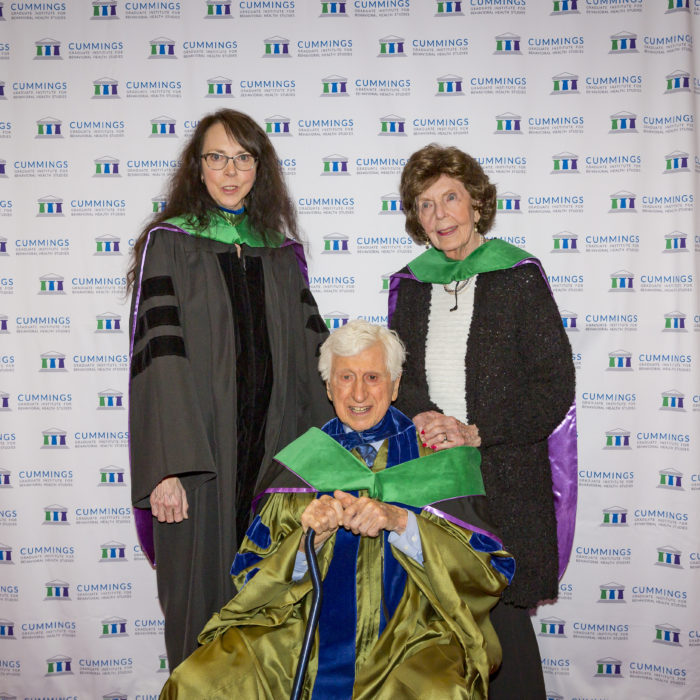
On January 25, 2020, Cummings Graduate Institute for Behavioral Health Studies (CGI) bestowed honorary degrees to three innovators who were pivotal in the establishment, growth, and success of CGI.
The Honorary Doctor of Behavioral Health degree recipients included:
- Dr. Nicholas A. Cummings, Ph.D., Sc.D.
- Dr. Dorothy Cummings, MSW, D.H.L.
- Dr. Janet L. Cummings, Psy.D.
Dr. Cara English, CEO and Director of the DBH program, presented the recipients with the first honorary degrees in the history of the institution at the 2020 DBH Commencement Ceremony. The event was held in Reno, NV, the place where in 2014, the concept and first plans for Cummings Graduate Institute for Behavioral Health was formed. At the launch of the ceremony Dr. English stated, “The idea behind this institution was a simple one. That with hard work and a strong vision for what healthcare can be, a small group of thoughtful, concerned people can make a difference. Indeed, as Margaret Mead has said, it’s the only thing that ever has.” Through their vision and dedication to innovation, Drs. Cummings founded an institution dedicated to changing the way the world experiences healthcare.
About the Honorees
 Dr. Nicholas A. Cummings, Ph.D., Sc.D. received his bachelor’s degree in psychology from the University of California at Berkeley, his master’s degree in psychology from Claremont Graduate School, and his doctorate in clinical psychology from Adelphi University. He has been awarded six honorary doctorates, most recently an honorary DBH from CGI, for his innovations in diverse fields including psychology, education, and the Greek classics.
Dr. Cummings launched the professional school movement in psychology by founding four campuses of the California School of Professional Psychology. Dr. Cummings designed and launched the state-of-the-art Doctor of Behavioral Health program at Arizona State University in 2007. In 2014, he and his daughter Janet co-founded the Cummings Graduate Institute for Behavioral Health Studies to focus on their mission to educate integrated care professionals to best deliver whole-person healthcare to diverse communities and to improve access to quality healthcare for all people.
Foreseeing the industrialization of healthcare, Dr. Cummings founded American Biodyne, the nation’s first and only psychology-driven managed behavioral health organization (MBHO). Dr. Cummings has written over 450 book chapters and journal articles, along with 51 books, 10 with daughter Janet. He presently serves as founding member of the CGI Board of Directors and as an active member of the Board of Directors for the Nicholas and Dorothy Cummings Foundation in Reno, Nevada.
 Dr. Dorothy Cummings, MSW, D.H.L. attended the University of California, Berkeley, where she completed an undergraduate degree and a Master’s Degree in Social Work. After meeting Nick Cummings, Dorothy held various positions, including one at Mendocino State Hospital in California, while working to help Nick complete his M.A. and Ph.D. in Psychology. The two have been married for over 70 years.
Dr. Cummings highly values charitable and humanitarian endeavors, and was a driving force behind the creation of The Nicholas & Dorothy Cummings Foundation, The Cummings Foundation for Behavioral Health, and their many educational and other charitable projects. In recognition of her philanthropic leadership, she was awarded an Honorary Doctorate of Humane Letters from the University of Akron in May of 2013.
Dr. Janet Cummings, Psy. D., is the daughter of Drs. Nicholas and Dorothy Cummings. She has earned bachelors and masters degrees in Pre-medicine and linguistics, minoring in Genetics and Molecular Biology, and a doctoral degree in Clinical Psychology. During her doctoral program, she completed Pharmacology and Psychopharmacology courses in Wright State University’s medical school and excelled in Pharmacology, Biological Psychology, and Neuroanatomy/Neurology.
 Dr. Cummings has served as President of The Nicholas & Dorothy Cummings Foundation since its inception in 1995. Under Janet’s direction, the Foundation has sponsored projects focused on the integration of behavioral health into primary care medicine, including the launch of the first Doctor of Behavioral Health (DBH) Program at Arizona State University, founding the Cummings Graduate Institute, and updating the design of the Doctor of Behavioral Health program at CGI. She has authored over two dozen journal articles and book chapters, and co-authored or co-edited ten books with her father. Dr. Cummings serves as the resident medical literacy subject matter expert for the DBH program at CGI, where she receives outstanding student ratings and is considered a favorite Professor.
Reflecting on the vision of Drs. Cummings for Cummings Graduate Institute and the Doctor of Behavioral Health Degree program, Dr. English shared, “We set out to deliver the program that Dr. Nicholas Cummings envisioned along his 60+ years of clinical leadership and entrepreneurship in the fields of psychology and behavioral health; the graduate program that would fill the gaps the World Health Organization agreed were missing in traditional medical and behavioral health training programs. In the five years since we first met in Reno, we have built a university and a program that I am amazed by; one that I am incredibly proud of. We have met every challenge, including our biggest one yet in July 2019, achieving institutional accreditation. We have attracted the kind of people who are ready to roll their sleeves up and get their hands dirty, so to speak, in changing healthcare for the better for all of us. We owe our accomplishments to our friends and supporters. No one achieves anything alone.”
To learn more about Cummings Graduate Institute for Behavioral Health Studies and the Doctor of Behavioral Health degree program, visit https://cummings.wpengine.com.