 When Mahani Soale Fuseini, M.ED, CMHC, started their research at Cummings Graduate Institute for Behavioral Health Studies (CGI) in the Doctor of Behavioral Health (DBH) program, they were not chasing a theoretical question. They were responding to something they had seen over and over again in practice.
“Fragmented systems, limited workforce capacity, and insufficient integration between medical, behavioral, and social services continue to contribute to poor mental health outcomes and health inequities,” they wrote. For children and families already navigating poverty, instability, or limited access to care, those gaps are not abstract. They are decisive.
The problem, Mahani believed, was not that professionals were not trying hard enough. It was that the systems surrounding them were not built to work together. “These challenges cannot be solved through siloed clinical care alone,” they explained. That conviction shaped both the focus of their research and the way they approached it.
The DBH program encouraged them to look beyond individual treatment models and toward the structures that determine whether care actually reaches people. Coursework grounded in integrated care, leadership, and implementation science pushed the research away from ideal scenarios and toward real conditions.
“The curriculum encouraged a focus on feasibility, scalability, and sustainability,”
Mahani said, noting that the goal was not to imagine a perfect system, but one that could function inside existing organizations.
Their research examined two forces often discussed separately in healthcare. One was the growing use of AI-enabled decision support tools to improve coordination and clinical decision-making. The other was the role of community-based social support in addressing the social conditions that shape mental health outcomes.
What emerged was not an argument for technology as a cure-all. “Technology alone is insufficient without strong community and system infrastructure,” Mahani said. At the same time, they found that community programs are most effective when supported by data-driven systems that help providers communicate and align services. When those elements work together, people are more likely to receive the right care at the right time.
The implications extend beyond any single organization. For healthcare systems serving underserved populations, the research offers a clear message. Innovation without equity falls short. Community care without coordination struggles to scale. The most effective models balance both.
Completing the research also clarified Mahani’s professional direction. They see themselves as a systems-focused behavioral health leader, working at the intersection of clinical care, technology, and population-level strategy.
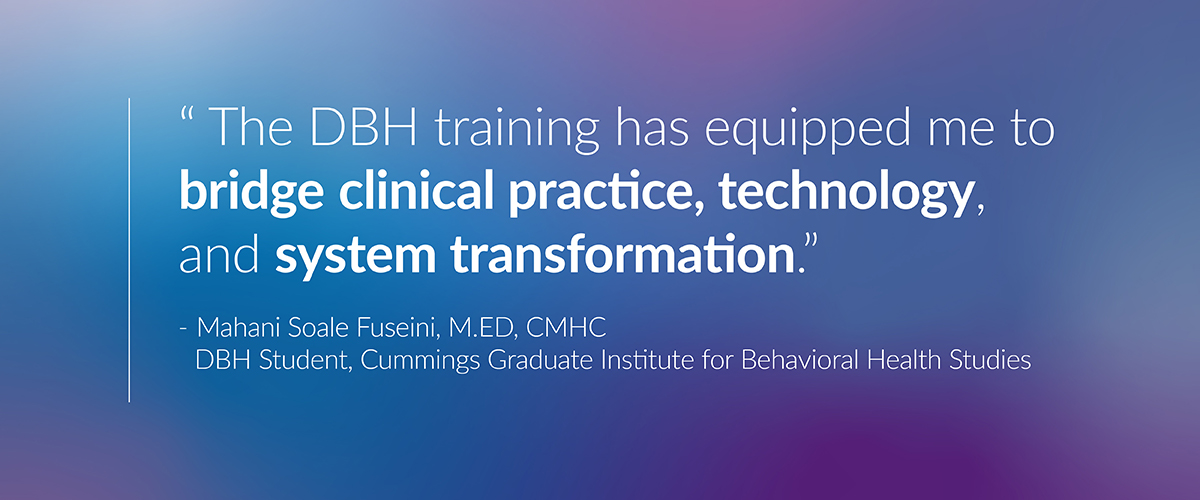
“The DBH training has equipped me to bridge clinical practice, technology, and system transformation,”
they shared, describing a future role focused on program development, quality improvement, and policy-aligned change.
There is no grand claim that this work will fix everything that is broken in behavioral health care. But it does something quieter and more difficult. It names the problem honestly and points toward solutions that acknowledge how care actually happens. By examining how technology, clinical practice, and community systems intersect, this work points toward models of care that are both scalable and responsive to real-world complexity.
Readers interested in a closer look at Mahani’s research, its methodology, and its implications for integrated behavioral health systems can explore the full research studies:
- Strengthening Community-Based Social Support Interventions to Improve Mental Health and Developmental Outcomes among At-Risk Children and Families in the United States
- Leveraging Artificial Intelligence: Driven Decision Support Systems to Improve Care Coordination and Health Outcomes in Underserved Populations