NewsPress

Carrying the Legacy Forward: CGI Alumni Continue to Disrupt and Redefine Healthcare

By October 22, 2025No Comments5 min read

Founders month at Cummings Graduate Institute for Behavioral Health Studies (CGI) is a time to honor visionary beginnings while celebrating how far the Doctor of Behavioral Health (DBH) community has come. For Dr. Leslie Allison Earl, DBH, LBHP, LPC-S, President of the CGI Alumni Association, the spirit of innovation and disruption that defined CGI’s founding continues to thrive through its graduates.

“The graduates of the CGI DBH program continue to be of the best and brightest minds,” Dr. Earl shared. “One way I see the alumni carrying the legacy of CGI forward is by utilizing their unique voices and continuing to disrupt and innovate healthcare. Out of the projects I have seen, there are so many opportunities for the upcoming graduates to change how the world experiences healthcare, just the way CGI intends.”

Every DBH graduate emerges from CGI with a shared purpose, to disrupt, to lead, and to humanize healthcare systems that have long needed transformation. For Dr. Earl, seeing that purpose unfold across the nation, and now globally, is one of the most inspiring parts of her work.

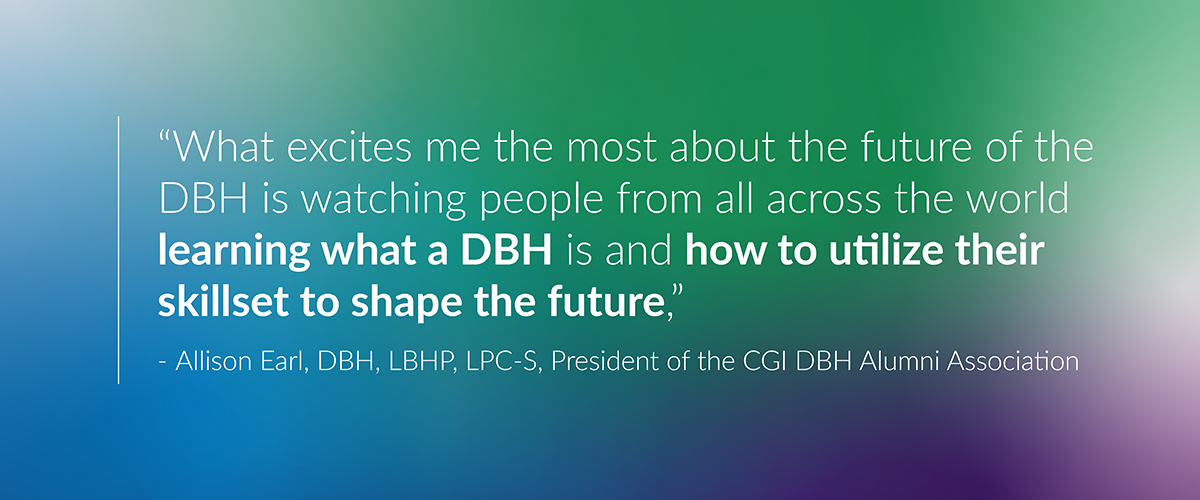
“What excites me the most about the future of the DBH is watching people from all across the world learning what a DBH is and how to utilize their skillset to shape the future,” she said. “It is my hope that the more DBHs we get across the US, the better the healthcare system and job market for DBHs in states where it is less recognized will be.”

Her optimism reflects the expanding reach of CGI’s mission of disrupting healthcare by preparing entrepreneurial integrated care professionals through innovative and affordable quality distance education programs, grounded in the Biodyne Model, and focused on delivering human-centered care, population health improvements, and medical cost savings. As healthcare systems confront rising costs, burnout, and fragmentation, DBHs are stepping in with data-driven solutions and human-centered care models that bridge the gap between treatment and prevention, policy and practice.

Igniting Innovation Through Community

Behind every disruptor is a community that fuels their vision. The CGI Alumni Association serves as that vital network for continued learning, collaboration, and shared purpose. For Dr. Earl, the association keeps alive the same spark of purpose that began in CGI’s classrooms.

“The Alumni Association has worked to increase innovation, disruption, and progress by encouraging the newest of DBHs to pursue what feeds their spirit,” Dr. Earl explained.

“When DBHs put their mind to something, there is little holding them back which is different than many of the other doctorate programs. The powerful instructors in the DBH program light the fire and the alumni association keeps stoking that fire to keep the DBHs and newest graduates thinking outside of the box consistently while creating community.”

This ongoing mentorship and encouragement are what make the DBH network so unique, it’s a family of innovators who refuse to accept “good enough” when better is possible. Through research, practice, and advocacy, CGI alumni are proving that disruption, when guided by compassion and equity, can be one of the most powerful forces in healthcare reform.

Redefining Leadership and Inspiring the Next Generation

As the DBH community expands, so does its definition of leadership. Dr. Earl sees a future where DBH graduates lead not only from executive offices and research institutions, but from every corner of healthcare, where they model inclusion, collaboration, and courage.

“As CGI produces more and more DBH alumni coming from different backgrounds are not only innovating in the healthcare industry, but also in the role of leaders,” she reflected. “With the younger generations graduating, they are not only showing what leadership can look like with more collaboration and disruption versus sticking to the past ways of producing good leaders.”

That evolution reflects CGI’s founding vision to improve the way the world experiences healthcare. DBH alumni are redefining what it means to lead, not just managing systems, but transforming them from the inside out.

And for those considering joining this growing movement, Dr. Earl offers a message:

“No matter your background or your area of expertise, the DBH program and the alumni organization will offer experienced mentors and educators to assist you in pursuing what you believe in while teaching you how to innovate effectively and become a disruptor in the broken healthcare system,” she said. “Please join us in helping to improve the quality of healthcare across the US and the world.”

As CGI continues to grow and evolve, its alumni are living proof that innovation is not just about new ideas, it’s about people willing to carry forward a vision of better care for all.


 

Testimonials

As a member of the AAPI community, I’m very familiar with the barriers to mental health services and the need to break through the glass wall of cultural stigma that prevents many from receiving potentially life–saving treatment. I was the only Asian American person in my master’s cohort, the only Asian American person in many of my clinical work settings, the only Asian American person to walk into many of the professional settings that I pushed myself to show up to. In my current practice, I’m constantly reminded by my patients of how difficult it is to find an Asian American mental health provider, though this reminder constantly informs me that more needs to be done for my community. Day after day, I read stories of Asian American people who die by suicide as a consequence of our culture’s avoidance of mental health topics. As a DBH, my biggest goal is to use my expertise in whole–person care to amplify the conversation around mental health and help my community understand that mental healthcare is not a privilege that we are not entitled to, it is a crucial part of our healthcare that will manifest differently in us than what many Western psychology or psychiatry textbooks will describe, and that our unique experience of mental health issues are valid, important, and is time to be part of the larger conversation.

Willam Chum, LMHCDBH Candidate, Cummings Graduate Institute for Behavioral Health Studies - September 16, 2022

The Doctor in Behavioral Health (DBH) program has changed my understanding of the subject and career path. Before this academic journey, my knowledge of behavioral health was primarily theoretical, including essential ideas and methods. However, the DBH curriculum combined intense academic research with practical application, helping me understand behavioral health from multiple angles. Recognizing mental health as part of total health changed my perspective. The biopsychosocial model, which showed how biological, psychological, and social variables affect mental health, was stressed in the DBH curriculum. This comprehensive approach made me realize how complex human behavior is and how important it is to address mental health issues. Effective interventions must target the individual’s surroundings, relationships, and life experiences, not just symptoms. The curriculum also gave me enhanced evidence-based practice training to execute successful solutions. Studies methods and data analysis classes improved my critical thinking and allowed me to evaluate and apply behavioral health studies. This gave me the confidence to contribute to the field’s knowledge base through practice and research.

Dr. Rhea Hill, DBH, LPCDBH Alumna, Cummings Graduate Institute for Behavioral Health Studies - February 17, 2025

This program will change how you present to the world, not just as a professional but as an individual. Understand this is work but the work is worth it and the journey is undeniably transformative. If you are seeking a doctorate for the title, this is not the program for you. If you are seeking a doctorate to interrupt and disrupt the course of healthcare, then this is the program for you. You won’t find a more supportive program with professors who are dedicated to your success and your education. This program is not about the regurgitation of information. It is about the appropriate applied application of knowledge and information to push forward and become an advocate for equitable and quality care for all.
Brandy K. Biglow LMHC, CCTP, QSDBH Candidate, Cummings Graduate Institute for Behavioral Health Studies - February 5, 2024

The Doctor of Behavioral Health (DBH) program has definitely transformed my understanding of behavioral health. Understanding the links between physical and mental health has taught how to make better treatment decisions. The DBH program has also given me insights that otherwise would not be possible and allows me to view individuals through a lens that I was previously ignorant of. This program has helped me grow into a more confident individual, provider, and parent.

Cory H. Cannady, BCBA, LBADBH Candidate, Cummings Graduate Institute for Behavioral Health Studies - March 13, 2024

The DBH program has reinforced my vision of viewing behavioral health (BH) as an integrated component of the healthcare system rather than a siloed service. As a practitioner in the focused BH realm of substance use disorder (SUD) treatment, I observe on a regular basis how identifying and serving SUD patients is often missed, ignored and stigmatized in primary healthcare, despite the fact that early intervention at these check-points often has the potential to intervene earlier and lessen the negative SUD outcomes frequently seen by the time a patient reaches specialty SUD services. Reinforcement received in my DBH program has motivated me to promote integration as a leader in my workplace and is a primary factor in considering the long-term trajectory of my individual career path.

Kenneth L. Roberts, MPS, LPCC, LADCDBH Candidate, Cummings Graduate Institute for Behavioral Health Studies - November 5, 2024

Graduating from the DBH program has influenced and enhanced my approach to addressing behavioral health challenges and making a difference in the field by preparing me to become a serious business owner. Through the DBH program, I understand now that becoming a business owner not only assists me in reaping the financial benefits of working for myself, but the program also offers me a sense of freedom to make a difference in an individual’s life.

Dr. Rebecca K. Wright, DBH, LBA, BCBA, QBADBH Alumna, Cummings Graduate Institute for Behavioral Health Studies - December 18, 2024

I have always wanted to pursue a higher degree but never found a program that met my needs. When I investigated the DBH program, I can honestly say I was excited. It was a program that would expand my knowledge in behavioral health but also how it relates to physical health. The philosophy of treating the whole person was exactly what I was looking for.

Elizabeth Nekoloff, M.Ed., LPCC-S, NCCDBH Candidate, Cummings Graduate Institute for Behavioral Health Studies - January 16, 2025

Prior to obtaining my DBH, I practiced behavioral health within the boundaries of behavior analysis. The DBH degree has given me the ability to broaden my scope of competence allowing me to provide a higher quality of care to my clients through a person-centered approach, while still staying within my scope of practice. I was in the beginning stages of opening my business when I enrolled in the DBH program which set my trajectory towards being a stronger leader. The program equipped me with essential healthcare leadership and entrepreneurial skills, allowing me to ensure high-quality services for my clients and foster a supportive work environment for our staff. It has also given me the confidence to expand my business and pursue other healthcare ventures, reaching a broader range of patients in need.

Dr. Pauline Tolentino Pablo, DBH, BCBA, IBADBH Alumna, Cummings Graduate Institute for Behavioral Health Studies - January 21, 2025

Although I have worked with many patients who have mental health diagnoses, or behaviors which make managing their medical diagnoses and day to day life difficult, the DBH program at CGI is broadening that knowledge and providing a deeper understanding of behavioral health and how best to help these individuals manage their health and improve their quality of life. This will allow me to provide and advocate for more meaningful and seamless integrated care, providing new tools for my intervention toolbox, and the confidence and skills to collaborate within and lead whole person focused interdisciplinary teams. I also anticipate building upon my knowledge as a nurse case manager and long time caregiver, as well as my personal passions and professional vision, learning about processes and operations, to be in position to start up and lead my own company one day, offering the services and care I know every person should have access to.

Hollie Wilson, MSN, RN, CCMDBH Candidate, Cummings Graduate Institute for Behavioral Health Studies - February 11, 2025

The DBH program will open opportunities for me to contribute to healthcare system innovation, particularly through trauma-informed care and integrated behavioral health settings. I will be better positioned to advocate for and implement holistic care models that improve health outcomes for underserved populations. Ultimately, this program will help me transition into higher-level roles, such as a director or consultant in behavioral health, where I can influence broader system changes and contribute to the future of healthcare delivery.

DeKyn Rashad Peters, MPH-CHES,BSW/BA,APCDBH Candidate, Cummings Graduate Institute for Behavioral Health Studies - March 4, 2025

Accreditation & Affiliates

Partners