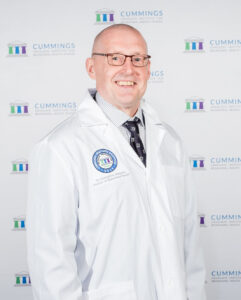
 Cummings Graduate Institute for Behavioral Health Studies (CGI) is proud to celebrate the achievements of Dr. Kenneth L. Roberts, a Doctor of Behavioral Health (DBH) alumnus who has recently stepped into a key leadership role as the new Director of Behavioral Health at a Federally Qualified Health Center in Washington, D.C. For Dr. Roberts, this position is far more than a title, it represents the culmination of years of dedicated preparation and an opportunity to advance behavioral health integration in one of the communities that needs it most.
“I am serving as the Director of Behavioral Health for a Federally Qualified Health Center in Washington DC,” he said. “I was drawn to the role because it represents a direct opportunity to apply my training from CGI as the point person for leading behavioral health integration across a primary health care system.” His first priority, he adds, is
“embedding behavioral health specialists in our clinics to support our patients and caregivers.” Roberts sees the opportunity as both urgent and deeply meaningful. “I am passionate about leading an evidence-based initiative with the potential to dramatically improve both patient experience and outcomes.”
The organization he now helps lead was created to support the Latino community, many of whom navigate trauma stemming from both their home countries and their experiences in the United States. Roberts believes that integrated behavioral health, embedded, routine, and culturally responsive, is essential to their healing. “Many of our patients are under-resourced and underserved,” he said. “Many are dealing with cultural trauma both from their native country and fear/hostility in the US. Being able to provide integrated behavioral health support as part of standard health care for the population creates opportunities for individual and family healing.”
Roberts credits the DBH program at CGI with shaping the way he approaches innovation and leadership.
“Our CGI training was always focused on innovation and disruption,” he said. “It reminds me every day to set aside doubt (impostor syndrome) and focus on taking actions that support positive change whenever and wherever I can!”
Even as he steps into this new position, Roberts remains clear-eyed about the scale of the work ahead. “I doubt I’ll actually live to see a truly affordable, patient first, integrated health system,” he reflected, “but I hope I’ll have a hand in moving things in that direction.” What drives him now, he says, is a combination of vision and preparation: “I am motivated by having the vision for innovative change and the training to actually carry it out.”
Dr. Roberts’ new role marks not just a professional milestone, but a continuation of a career dedicated to expanding access, improving outcomes, and strengthening the connection between behavioral and medical care. His leadership stands as a reminder of how DBH graduates are reshaping healthcare, one system, one clinic, and one community at a time.