DBH Student ProfilesNewsPress

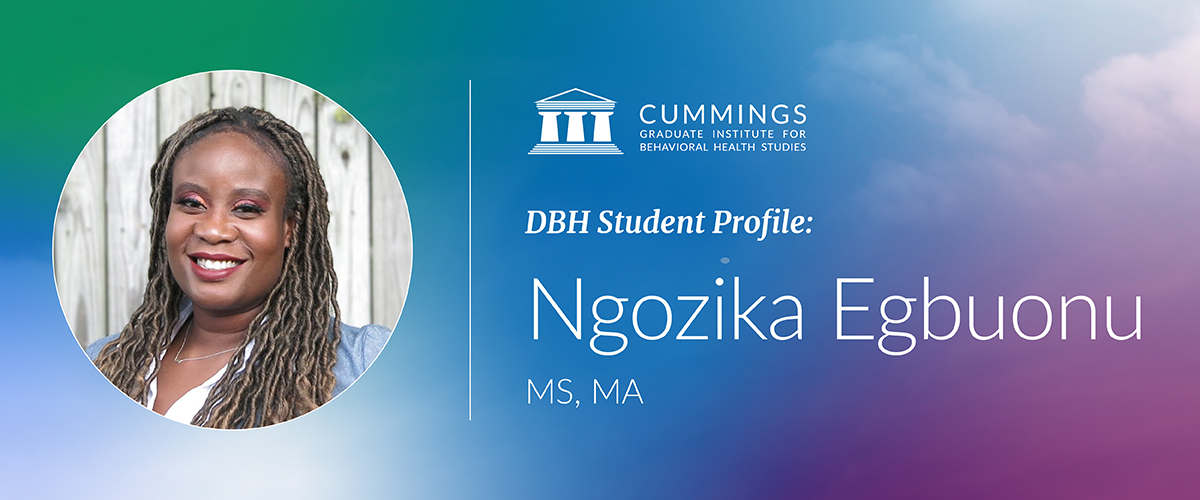
DBH Student Profile: Ngozika Egbuonu, MS, MA

By February 11, 2026No Comments8 min read

From Insight to Impact: Ngozika Egbuonu on Leading Healthcare Change with Data, Humanity, and Lived Experience

Ngozika Egbuonu is a Doctor of Behavioral Health (DBH) candidate whose work sits at the intersection of analytical insight and strategic communication. With advanced degrees in Psychology and Medical Humanities and Bioethics, she brings a distinctive dual perspective to roles that demand both quantitative rigor and creative, human-centered thinking. Her experience spans project management, fundraising, event coordination and planning, program direction and leadership, research, and volunteer leadership, equipping her to drive initiatives from conception through execution. Passionate about fostering inclusive environments and empowering teams, Ngozika thrives on leveraging data, storytelling, and collaboration to deliver meaningful impact to patients, communities, and all in need. In this interview, she shares how the DBH program has shaped her approach to challenging the healthcare status quo, her vision for a more inclusive and integrated future of care, and the personal motivations that drive her commitment to systems-level change.


How has the DBH program influenced your approach to behavioral health?

The Doctor of Behavioral Health (DBH) program has influenced my approach to addressing behavioral health challenges and making a difference in the field by equipping me with both the research and clinical knowledge necessary for informing healthcare access and improvement from an informed and expert position. Now, I can not only identify the issues preventing integrated behavioral health teams from achieving their health and patient care goals, but I can also provide evidence-based approaches and interventions that support my reasoning for designing programs.

In addition to equipping me with the education and applicable skills needed to effect change in healthcare delivery, the DBH program has also inspired me to think critically about innovative and new ways to challenge the healthcare status quo. While systems level approaches have been at the core of my health equity organizing and advocacy ethos, the DBH program has helped me shape a clearer and more compelling narrative for how all Americans can contribute to making healthcare improvement a reality for all.

What are your future career goals, and how do you envision the DBH program contributing to your success?

My primary professional and academic interests within behavioral health center around the use of technology, inclusive and accessible learning design, and the expertise of clinical teams to transform how both caregivers and care receivers engage with the healthcare system. From efforts to advance the Triple, Quadruple, and Quintuple Aims, to the evolving landscape of healthcare careers, I am motivated by a relentless desire to positively influence the future of clinical care. I want all people to have a clearer understanding of the overlapping impacts of biology, environment, and the mind on human health.

Through the DBH program, I have found the voice and words to describe and visualize what the next chapter of healthcare will look like. It is a story defined by behavioral health and partly by me. My education has prepared me to not only craft a reimagined story of healthcare where people are truly supported toward health improvement and avoiding preventable illness and death, but also help shape the final outcome by strategically sharing my knowledge and expertise with other healthcare disruptors.

Together, we can move the right levers of societal change necessary for truly changing healthcare in America for the better.

Can you share an experience that shaped your understanding of integrated behavioral healthcare?

The most memorable experience in my DBH journey has to be how often I hear a story about healthcare or healthcare delivery that my education has uniquely positioned me to tackle with data, humanity, and experience. While I know I can’t solve every issue plaguing the healthcare system in America, and globally, I know that I have a very special skill set that has prepared me to support moving our society towards a brighter, healthier future where we focus on healing the whole human and not just the diagnosis.

What fuels your passion for advancing integrated behavioral health, and how do you stay motivated?

My kids and their futures drive and motivate me to pursue the advancement of behavioral health in the integrated care context. Having seen what cancer alley has done to my peers who just happened to have the luck of being born in that part of Louisiana or North Carolina, or watching my regional fishermen and women worrying about what generations of their families will do if climate change mitigation doesn’t become part of my state’s policy agenda, or how delays on transportation improvement projects mean more people who look like me die earlier and more painfully due to lack of adequate means to travel to a doctor’s appointment— I cannot and will not sit idly by and allow my skills and talents to be wasted while more people go harmed.
Enough is enough. No child– whether I bore them myself or not– should have to be burdened with the tragic responsibility of having to fight to eat, breathe, and live. While I know healthcare can’t solve all of those issues, I want to be part of solutions that ensure neither my children or any generation after me has to worry about how they can afford to live. Life is hard enough without having to worry about whether you can afford medication or food. No person should have to make that choice and if I can help make sure my children and future children don’t have to be saddled with that sort of decision, then I have found a purpose worth living for.

What advice would you give to prospective students or professionals considering the DBH program?

Do not feel pressured to get this degree right now.

What I love about this program is that it is such an intergenerational education. Whether you’ve been working in behavioral health your whole career, are an emerging leader, or someone looking to narrow your focus and cause a bit more, this degree has immense value for how it can shape your career now and in the future.

This degree is also versatile. Even if you are not seeking to deliver or provide clinical care directly to patients, you can benefit from this program as an integrated behavioral health leader, entrepreneur, psychologist, nurse, BCBA, social worker, etc. You have a multitude of ways to leverage the skills, knowledge, and network this program provides you. The key question is: are you ready?

And even if you’re not sure, do it. This program will stretch you but in the ways you need it to. Don’t let that self doubt, the chatter, or even your current circumstances try to deter you from what you already know: you were drawn to this program for a reason. Now, it’s time for you to take that leap and see just exactly what that reason is. You won’t regret it.


As Ngozika Egbuonu continues her journey in the Doctor of Behavioral Health program, she exemplifies the kind of thoughtful, courageous leadership today’s healthcare system urgently needs. Through the DBH, Ngozika has gained the language, tools, and confidence to translate lived experience, data, and values into actionable strategies that advance integrated, whole-person care. Her evolving career reflects the power of doctoral-level preparation that is both rigorous and deeply human, positioning her not only to respond to today’s behavioral health challenges, but to help shape a more equitable and compassionate future of care. CGI is proud to support Ngozika Egbuonu as she turns purpose into impact and vision into lasting change.


Connect with Ngozika Egbuonu


Ngozika Egbuonu on Her Commitment to Integrated Behavioral Health


Check Out Ngozika Egbuonu on the Disruptors at Work Podcast
In this episode of Disruptors at Work: An Integrated Care Podcast, special host Ngozika Egbuonu, Doctor of Behavioral Health (DBH) program student at Cummings Graduate Institute for Behavioral Health Studies (CGI) and Director of Programs at the Technology Association of Grantmakers, sits down with Dr. Nnanyelugo Gerald Odezulu, Senior Biocompatibility Specialist at ConMed, for a conversation on advancing global health equity through integrated care. They explore how DBHs can drive change in rural, urban, and lower-income communities by expanding health literacy, strengthening cross-disciplinary collaboration, and transforming care delivery systems. This episode offers practical insights and inspiration for healthcare professionals committed to shaping a more accessible, effective, and equitable future in healthcare.


Read more

Testimonials

As a member of the AAPI community, I’m very familiar with the barriers to mental health services and the need to break through the glass wall of cultural stigma that prevents many from receiving potentially life–saving treatment. I was the only Asian American person in my master’s cohort, the only Asian American person in many of my clinical work settings, the only Asian American person to walk into many of the professional settings that I pushed myself to show up to. In my current practice, I’m constantly reminded by my patients of how difficult it is to find an Asian American mental health provider, though this reminder constantly informs me that more needs to be done for my community. Day after day, I read stories of Asian American people who die by suicide as a consequence of our culture’s avoidance of mental health topics. As a DBH, my biggest goal is to use my expertise in whole–person care to amplify the conversation around mental health and help my community understand that mental healthcare is not a privilege that we are not entitled to, it is a crucial part of our healthcare that will manifest differently in us than what many Western psychology or psychiatry textbooks will describe, and that our unique experience of mental health issues are valid, important, and is time to be part of the larger conversation.

Willam Chum, LMHCDBH Candidate, Cummings Graduate Institute for Behavioral Health Studies - September 16, 2022

The Doctor in Behavioral Health (DBH) program has changed my understanding of the subject and career path. Before this academic journey, my knowledge of behavioral health was primarily theoretical, including essential ideas and methods. However, the DBH curriculum combined intense academic research with practical application, helping me understand behavioral health from multiple angles. Recognizing mental health as part of total health changed my perspective. The biopsychosocial model, which showed how biological, psychological, and social variables affect mental health, was stressed in the DBH curriculum. This comprehensive approach made me realize how complex human behavior is and how important it is to address mental health issues. Effective interventions must target the individual’s surroundings, relationships, and life experiences, not just symptoms. The curriculum also gave me enhanced evidence-based practice training to execute successful solutions. Studies methods and data analysis classes improved my critical thinking and allowed me to evaluate and apply behavioral health studies. This gave me the confidence to contribute to the field’s knowledge base through practice and research.

Dr. Rhea Hill, DBH, LPCDBH Alumna, Cummings Graduate Institute for Behavioral Health Studies - February 17, 2025

This program will change how you present to the world, not just as a professional but as an individual. Understand this is work but the work is worth it and the journey is undeniably transformative. If you are seeking a doctorate for the title, this is not the program for you. If you are seeking a doctorate to interrupt and disrupt the course of healthcare, then this is the program for you. You won’t find a more supportive program with professors who are dedicated to your success and your education. This program is not about the regurgitation of information. It is about the appropriate applied application of knowledge and information to push forward and become an advocate for equitable and quality care for all.

Brandy K. Biglow LMHC, CCTP, QSDBH Candidate, Cummings Graduate Institute for Behavioral Health Studies - February 5, 2024

The Doctor of Behavioral Health (DBH) program has definitely transformed my understanding of behavioral health. Understanding the links between physical and mental health has taught how to make better treatment decisions. The DBH program has also given me insights that otherwise would not be possible and allows me to view individuals through a lens that I was previously ignorant of. This program has helped me grow into a more confident individual, provider, and parent.

Cory H. Cannady, BCBA, LBADBH Candidate, Cummings Graduate Institute for Behavioral Health Studies - March 13, 2024

The DBH program has reinforced my vision of viewing behavioral health (BH) as an integrated component of the healthcare system rather than a siloed service. As a practitioner in the focused BH realm of substance use disorder (SUD) treatment, I observe on a regular basis how identifying and serving SUD patients is often missed, ignored and stigmatized in primary healthcare, despite the fact that early intervention at these check-points often has the potential to intervene earlier and lessen the negative SUD outcomes frequently seen by the time a patient reaches specialty SUD services. Reinforcement received in my DBH program has motivated me to promote integration as a leader in my workplace and is a primary factor in considering the long-term trajectory of my individual career path.

Kenneth L. Roberts, MPS, LPCC, LADCDBH Candidate, Cummings Graduate Institute for Behavioral Health Studies - November 5, 2024

Graduating from the DBH program has influenced and enhanced my approach to addressing behavioral health challenges and making a difference in the field by preparing me to become a serious business owner. Through the DBH program, I understand now that becoming a business owner not only assists me in reaping the financial benefits of working for myself, but the program also offers me a sense of freedom to make a difference in an individual’s life.

Dr. Rebecca K. Wright, DBH, LBA, BCBA, QBADBH Alumna, Cummings Graduate Institute for Behavioral Health Studies - December 18, 2024

I have always wanted to pursue a higher degree but never found a program that met my needs. When I investigated the DBH program, I can honestly say I was excited. It was a program that would expand my knowledge in behavioral health but also how it relates to physical health. The philosophy of treating the whole person was exactly what I was looking for.

Elizabeth Nekoloff, M.Ed., LPCC-S, NCCDBH Candidate, Cummings Graduate Institute for Behavioral Health Studies - January 16, 2025

Prior to obtaining my DBH, I practiced behavioral health within the boundaries of behavior analysis. The DBH degree has given me the ability to broaden my scope of competence allowing me to provide a higher quality of care to my clients through a person-centered approach, while still staying within my scope of practice. I was in the beginning stages of opening my business when I enrolled in the DBH program which set my trajectory towards being a stronger leader. The program equipped me with essential healthcare leadership and entrepreneurial skills, allowing me to ensure high-quality services for my clients and foster a supportive work environment for our staff. It has also given me the confidence to expand my business and pursue other healthcare ventures, reaching a broader range of patients in need.

Dr. Pauline Tolentino Pablo, DBH, BCBA, IBADBH Alumna, Cummings Graduate Institute for Behavioral Health Studies - January 21, 2025

Although I have worked with many patients who have mental health diagnoses, or behaviors which make managing their medical diagnoses and day to day life difficult, the DBH program at CGI is broadening that knowledge and providing a deeper understanding of behavioral health and how best to help these individuals manage their health and improve their quality of life. This will allow me to provide and advocate for more meaningful and seamless integrated care, providing new tools for my intervention toolbox, and the confidence and skills to collaborate within and lead whole person focused interdisciplinary teams. I also anticipate building upon my knowledge as a nurse case manager and long time caregiver, as well as my personal passions and professional vision, learning about processes and operations, to be in position to start up and lead my own company one day, offering the services and care I know every person should have access to.

Hollie Wilson, MSN, RN, CCMDBH Candidate, Cummings Graduate Institute for Behavioral Health Studies - February 11, 2025

The DBH program will open opportunities for me to contribute to healthcare system innovation, particularly through trauma-informed care and integrated behavioral health settings. I will be better positioned to advocate for and implement holistic care models that improve health outcomes for underserved populations. Ultimately, this program will help me transition into higher-level roles, such as a director or consultant in behavioral health, where I can influence broader system changes and contribute to the future of healthcare delivery.

DeKyn Rashad Peters, MPH-CHES,BSW/BA,APCDBH Candidate, Cummings Graduate Institute for Behavioral Health Studies - March 4, 2025

Accreditation & Affiliates

Partners

Leave a Reply