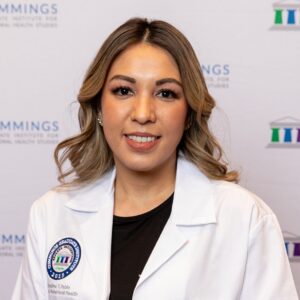
 There are moments when a career quietly transforms into a calling. For Dr. Pauline Pablo, DBH, BCBA, IBA, Cummings Graduate Institute for Behavioral Health Studies (CGI) Doctor of Behavioral Health (DBH) program alumna , that moment did not arrive with fanfare or applause. It came instead through a growing awareness, one shaped by lived experience, professional observation, and an unshakable sense of responsibility to a community she rarely saw reflected in positions of influence.
“I built my career in California,” she says, “and I was fortunate to work alongside other Asian and Pacific Islander professionals. But it was rare to see API clinicians in leadership or mentorship roles, roles that shape the future of our field.”
As a Filipino immigrant and a Board Certified Behavior Analyst, Dr. Pablo spent years navigating the intersections of identity and practice. Families sought her out not just for her clinical expertise, but for something less tangible and far more powerful, cultural understanding. “Several families requested me specifically because I understood their cultural needs,” she recalls. “That made the gaps very visible, especially in cultural humility training among non-API providers.”
Those gaps were not just anecdotal. In 2020, the Behavior Analyst Certification Board released demographic data that confirmed what Dr. Pablo had long felt. Only a small fraction of behavior analysts and technicians identified as Asian or Pacific Islander. The field that served increasingly diverse families did not reflect them.
At the same time, the world went quiet. Lockdowns during the COVID-19 pandemic forced isolation, but also connection. Like so many others, Dr. Pablo turned to online spaces to find community. What began as a few direct messages between three API behavior analysts quickly became something more.
“We talked about the shared challenges we were facing,” she says. “And about the importance of building something together.”
 From those conversations, the Asian and Pacific Islander Association for Behavior Analysis, APIABA, was born.
Representation, for Dr. Pablo, has never been about optics. It is not about checking boxes or meeting quotas. “True representation,” she says, “means visibility that is integrated, not performative.” It means seeing leaders, educators, and business owners who understand the nuances of language, family systems, immigration, and cultural values. It means shaping policy and practice from lived experience, not proximity.
The consequences of lacking that representation are profound. Cultural bias can quietly shape treatment goals. Language barriers can flatten meaning. Immigrant families may struggle to find providers who truly understand them, not just linguistically, but contextually. And the science itself remains under-disseminated within API communities, where behavior analysis is still largely unknown as a career path.
APIABA was created to address all of that and more.
As Vice President and co-founder, Dr. Pablo envisions the organization as a living, evolving ecosystem grounded in collectivism. “We want to honor shared community values,” she explains, “while still creating space for individual needs and leadership paths.”
That vision is already taking form through mentorship programs that center cultural identity, leadership pipelines that show API professionals a future at the highest levels of the field, and outreach efforts that extend beyond borders. Dr. Pablo speaks with particular excitement about connecting Western API professionals with counterparts across the globe. “There’s a desire, almost a calling, to support families worldwide,” she says. “And the need is immense.”
Her work is deeply informed by her training as a Doctor of Behavioral Health. The DBH, she explains, reshaped how she understands systems, and her place within them.
“A DBH understands cultural background and ethnicity as social determinants of health,” she says. “That lens changes everything.”
It changed how she leads. It changed how she advocates. And it changed how she sees people, not as roles or titles, but as whole beings. “Even when I’m working with colleagues or supervisees,” she reflects, “I approach them with a whole-person lens. Psychological safety matters. Professional quality of life matters.”
That training also gave her something she had not always felt entitled to claim: voice. “There’s a stereotype that API professionals are quiet followers,” she says. “Being able to speak up, to advocate, feels empowering, especially when your community has been flattened by the ‘model minority’ myth.”
When asked what she would say to emerging API clinicians and students searching for mentorship, her response is immediate and unguarded.
“Your voice matters,” she says. “Your cultural identity is a strength. Do not mask who you are to fit into systems that were never built for you.”
She knows that representation is not always easy to find locally. She didn’t find it at work. She found it online. And she built something from it. “You don’t have to grow alone,” she says. “Communities like APIABA exist because we need each other.”
Looking ahead, Dr. Pablo hopes APIABA becomes an enduring resource, not just for professionals, but for families, allies, and future generations. Her short-term goal is to deepen engagement and strengthen the organization’s foundation. Her long-term vision stretches outward, globally, toward sustainable impact.
Above all, she hopes the association remains what it was meant to be from the beginning.
“A place where people feel proud of who they are,” she says. “Where they feel valued. Where they feel supported.”
And in a field that too often overlooks the power of belonging, that may be the most radical intervention of all.
Explore the work of the Asian and Pacific Islander Association for Behavior Analysis and the growing community behind its mission.
- https://www.apiaba.org/
- https://www.instagram.com/api.behavioranalysis/
- https://www.facebook.com/API.BehaviorAnalysis/
- https://www.linkedin.com/company/api-behavioranalysis
Learn more about Dr. Pauline Pablo and her work advancing representation, leadership, and culturally responsive care by visiting her alumni profile and alumni spotlight.