There is a question almost everyone thinks about before applying to a doctoral program and almost no one says out loud.
It’s not “Will I get in?”
It’s not “Can I afford it?”
It’s not “Do I have the time?”
The real question is quieter, heavier, and far more personal:
“What will this ask of me and who will I become in the process?”
For professionals considering a Doctor of Behavioral Health, that question often surfaces late at night, between work demands, family responsibilities, and the weight of wanting to do more than survive inside broken systems. Many applicants already know healthcare intimately. They’ve worked inside it. They’ve watched patients fall through cracks no one seems responsible for fixing. They’ve felt the frustration of knowing what should happen and being unable to make it happen.
The decision to pursue a doctorate is rarely about credentials alone. It’s about readiness, not just to study, but to lead, disrupt, and carry responsibility forward.
At Cummings Graduate Institute, that unspoken question isn’t avoided. It’s quietly centered.
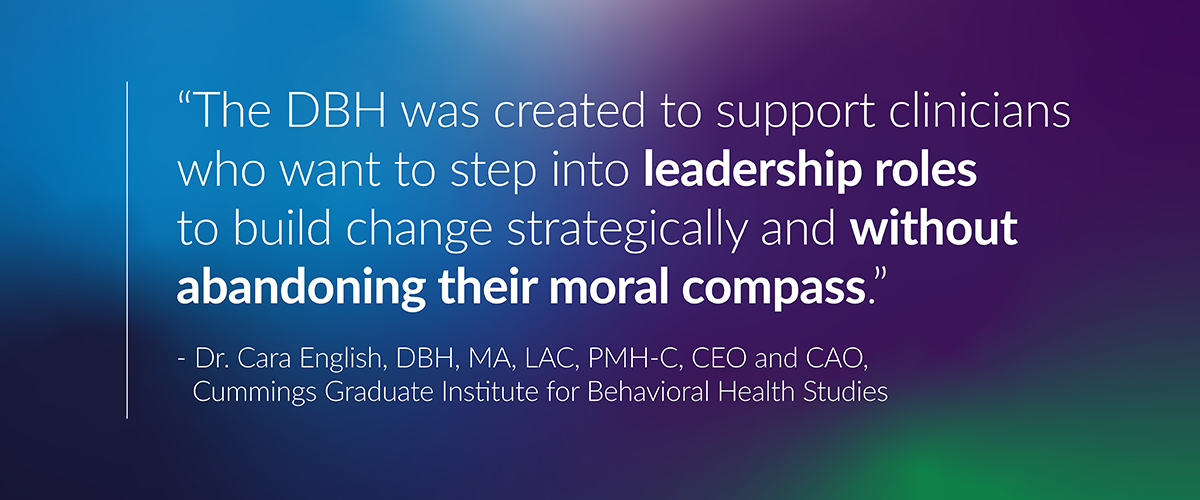
“Healthcare needs leaders who can hold truth, pace change, and protect their integrity inside imperfect systems,” said Dr. Cara English, CEO of Cummings Graduate Institute for Behavioral Health Studies. “The DBH was created to support clinicians who want to step into leadership roles to build change strategically and without abandoning their moral compass.”
The Doctor of Behavioral Health program was not designed for people looking to step away from the field. It was built for those already deeply embedded in it, clinicians, educators, administrators, policymakers, and system leaders who understand that behavioral health cannot be separated from physical health, community context, culture, or lived experience.
This is not a program that asks students to leave their lives behind. It asks them to bring their lives with them.
That distinction matters.
Unlike traditional doctoral pathways that privilege theory over application or isolate scholarship from real-world constraints, the DBH centers applied practice, integrated care, and systems-level change. Coursework is structured around the reality that students are working professionals, often while managing families, health challenges, and leadership roles of their own.
“The Doctor of Behavioral Health program is built for experienced healthcare professionals balancing demanding careers. Its distinctiveness lies in blending clinical expertise, medical literacy, and leadership development into a flexible model that directly applies to real-world practice,” said Dr. U. Grant Baldwin, Jr., Director of the DBH Program.
Students often arrive with a mix of confidence and doubt. They know their field. They know something isn’t working. What they’re unsure about is whether they’re “ready” for a doctorate.
But readiness, in this context, isn’t about perfection. It’s about willingness.
Willingness to question systems instead of individuals.
Willingness to examine how policy, power, and access shape outcomes.
Willingness to collaborate across disciplines rather than work in silos.
It’s also about humility, recognizing that leadership in behavioral health today requires listening as much as directing, and learning as much as teaching.
One of the quiet truths about doctoral education is that it changes how people see themselves. Not overnight. Not dramatically. But steadily, through research that refuses to stay theoretical and conversations that challenge assumptions long held as fact.
Students don’t simply leave with a degree. They leave with a different way of seeing care.
They ask better questions inside their organizations.
They recognize patterns that once felt invisible.
They develop language for problems they always sensed but couldn’t name.
And perhaps most importantly, they stop blaming themselves for systems that were never built to work the way patients needed them to.
The question no one asks out loud doesn’t disappear once someone applies. It follows them through the program. But over time, it shifts.
It becomes less about “Can I do this?”
And more about “How do I use this well?”
That is where the DBH lives, not as an endpoint, but as a turning point. A place where professionals stop carrying concern alone and start translating it into leadership, research, and action that reaches beyond individual practice.
For those standing at the edge of that decision, the question isn’t whether the work will be demanding.
It will be.
The question is whether they are ready to step into a role that allows them to shape the future of behavioral health, not in theory, but in practice.